
Filing Your Taxes for the First Time, Without the Stress

Filing taxes for the first time can feel like a pop quiz you never got to study for. W-2s, 1099s, deadlines, deductions — the jargon alone is enough to make your head swim. Here is the calming part: filing a federal tax return is a sequence of simple steps, and the IRS spells out nearly all of them in plain language on IRS.gov. This guide groups that information into one friendly walkthrough, so you know what to collect, what each form means, when things are due, and where to find free help. The paperwork language is half the battle, so test your terms with our Legal Lingo Quiz. One note up front: this article is general education. It is not personal tax advice.
Start with the Season's Calendar
Every tax year follows the same rhythm, but the IRS sets the exact dates afresh each year — always confirm the current season's announcements.
-
Late January: the season opens. The IRS starts accepting returns. For 2025 tax-year returns, the IRS began accepting them in late January 2026.
-
January to February: forms show up. Employers, banks, and other payers send you the same paperwork they send the IRS — a W-2 form from each employer, 1099s from everyone else. For the 2026 season, payers had to make W-2s and 1099-R forms available by February 2, 2026. If a form is missing, ask the payer first; still missing by the end of February, call the IRS at 800-829-1040.
-
Mid-April: the tax deadline. For tax year 2025, the due date was April 15, 2026, per IRS announcements.
-
Mid-October: the extension deadline. Filers who request an extension by April gain until roughly mid-October. An extension to file is never an extension to pay.
Build a Five-Pocket File
Gather everything into one place before you sit down to file. Think of a single folder with five pockets.
Pocket 1 — About you. Social Security numbers (or ITINs) for you and everyone else on the return, written exactly as they appear on the Social Security card. Add your correct name, current address, and the bank account and routing numbers where you want your refund sent.
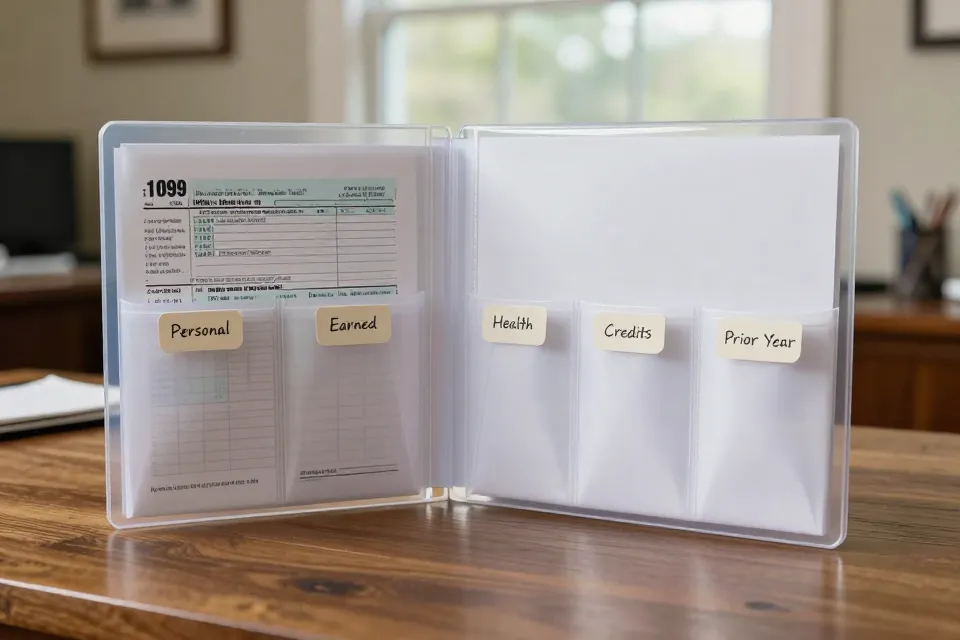
Pocket 2 — Money you earned. Every W-2 from every employer, plus any 1099 forms. If you had a side job, gig work, or freelance income, keep records of that income and its expenses here too.
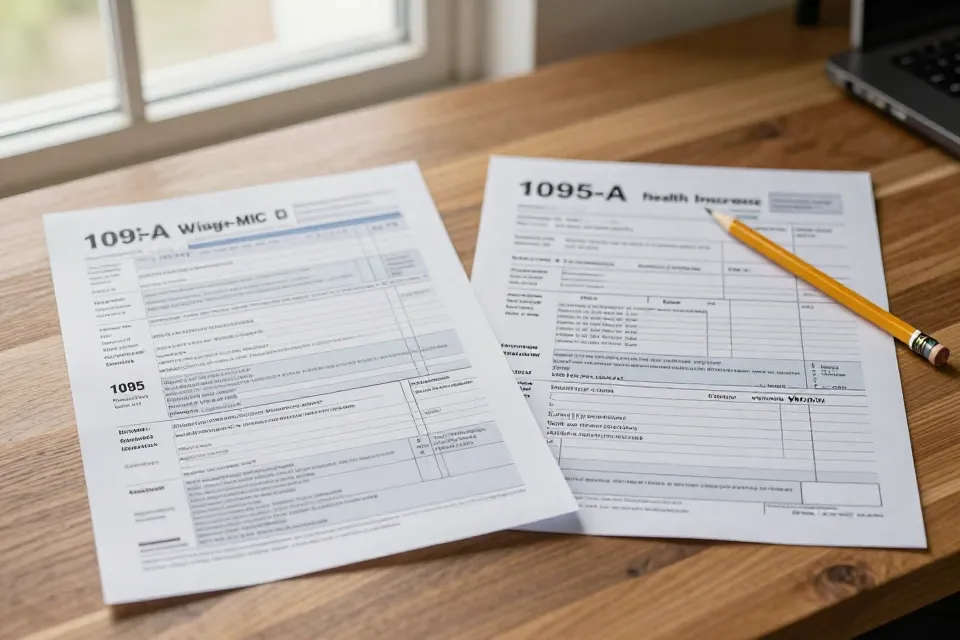
Pocket 3 — Health insurance. Form 1095-A if you bought a plan through the Health Insurance Marketplace. Keep any other 1095 forms you receive with your tax papers — they are for your records, not for mailing in.
Pocket 4 — Credits and deductions. Receipts for childcare, tuition, retirement contributions, health savings accounts, and gifts to charity. Many first-time filers take the standard deduction, but the paperwork is still how you claim credits that shrink your tax bill.
Pocket 5 — Last year's return. Your prior-year adjusted gross income (AGI) and refund amount. Never filed before? First-time filers simply use $0 for prior-year AGI.
W-2 vs. 1099: What Each Form Is Telling You
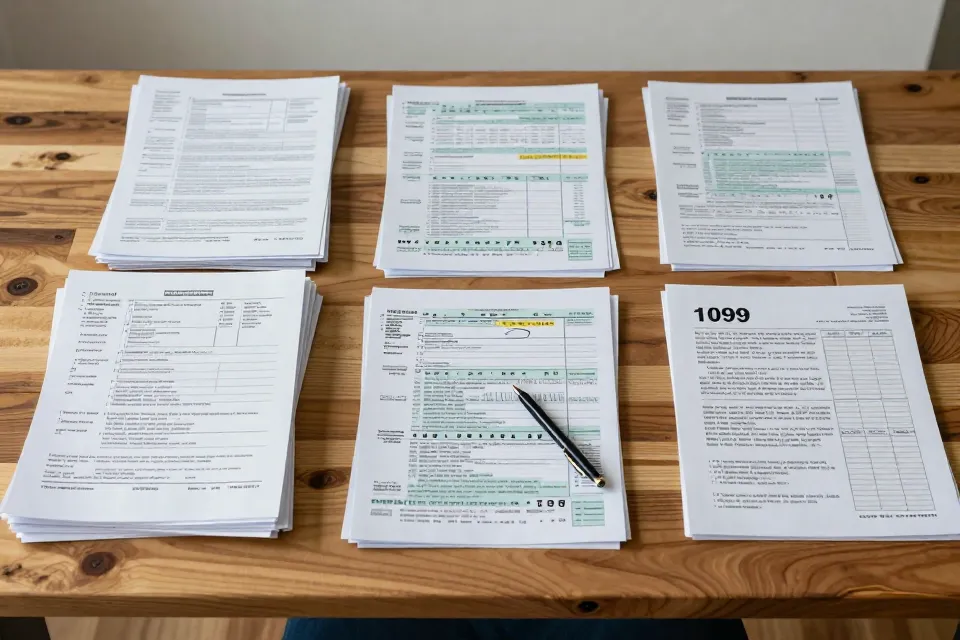
Payers send different forms for different kinds of money. Most first-time filers will meet these:
| Form | What it is telling you |
|---|---|
| W-2 | Wages from an employer, with federal tax already withheld |
| 1099-NEC | Freelance and gig work |
| 1099-INT | Interest from a bank or broker |
| 1099-DIV | Dividends you were paid |
| 1099-G | Government payments such as unemployment benefits |
| 1099-K | Payments from cards and online marketplaces |
| 1099-R | Money from a retirement plan or pension |
| SSA-1099 | Social Security benefits |
| 1095-A | Marketplace health coverage, used to reconcile premium credits |
The IRS lists these on its Gather your documents page. You may receive others — the rule is simple: report what the forms say.
Four Questions That Decide Most Returns
Almost everything else falls out of four basic questions.

1. Do I even have to file? Most U.S. citizens and permanent residents who work in the U.S. must file a return, but the requirement depends on income, age, filing status, and whether you can be claimed as a dependent. Quick example for tax year 2025: single filers under 65 had to file at $15,750 or more in gross income, married couples filing jointly at $31,500 (both spouses under 65). Net self-employment earnings over $400 also trigger a filing duty. Unsure where you stand? Use the free Do I need to file? tool on IRS.gov. And here is the twist: even below the line, filing can still pay off — you may get back withheld tax or claim refundable credits like the Earned Income Tax Credit.
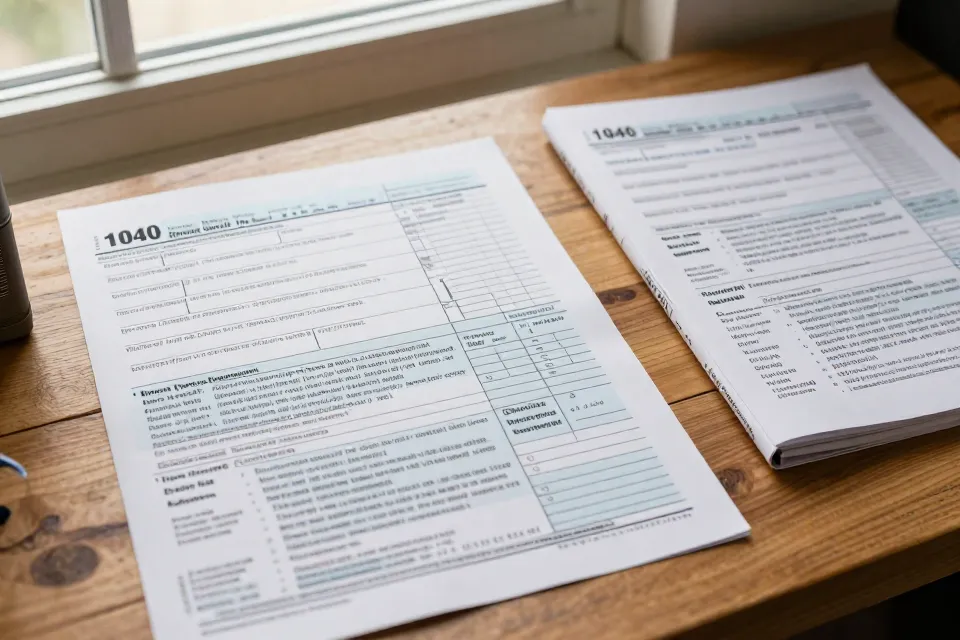
2. What is my filing status? The IRS offers five: single, married filing jointly, married filing separately, head of household, and qualifying surviving spouse. Your status sets your standard deduction and tax rates, and it depends on your marital status and, for some statuses, on who you support. If more than one status could apply, choose the one that gives the lowest tax; Publication 501 walks through the rules.
3. Standard deduction or itemizing? The standard deduction is a set dollar amount the IRS lets nearly every filer subtract from income before tax is figured. The amount depends on your filing status and is adjusted each year — for tax year 2025 it was $15,000 for single filers, $22,500 for head of household, and $30,000 for married couples filing jointly. Those figures change, so confirm the number for your tax year. Most first-timers simply take the standard deduction. You itemize only when your listed expenses add up to more than that amount.
4. Refund or balance due? Employers take tax out of each paycheck — that is withholding — and send it to the IRS in your name. At filing time, the math decides the outcome. If withholding overshot your actual tax, the IRS sends you the difference as a refund. If withholding fell short, you owe the difference. Neither outcome means you filed wrong. Owe more than you can pay at once? The IRS has payment arrangements — skipping the return is never the answer.

Free Ways to File (Yes, Really)
Free filing is not a trap, and it starts on the official site.
-
IRS Free File. With adjusted gross income of $89,000 or less (the limit for 2025 tax-year returns — the number moves, so check the current season), you can prepare and e-file your federal return at no cost with IRS partner software. Start at IRS.gov/freefile; the free deal only works through that door. Partners cannot charge hidden fees or sell refund-anticipation loans, and they guarantee their software's calculations.
-
Free File Fillable Forms. Any income level, bare-bones: no guided questions, no state return — still a genuine zero-cost option.
-
VITA and TCE. IRS-trained volunteers prepare basic tax returns for free for qualifying taxpayers.
-
MilTax. Free filing tools for eligible members of the military community, run through the Department of Defense.
Choose direct deposit when you file — it is the fastest way to get a refund, and most e-filed returns with direct deposit are paid within about 21 days.
Six Small Mistakes (and Six Easy Fixes)
First-time filers hit the same potholes year after year. Run through this list before you press submit:

- Names and Social Security numbers must match the Social Security card exactly — a mismatch can bounce the whole return.
- Pick the right filing status; the Interactive Tax Assistant on IRS.gov can help you choose.
- Double-check the math, or better, let the software do it for you.
- Re-read your bank routing and account numbers; one wrong digit delays a refund.
- Sign the return. Both spouses sign a joint return — e-filing handles the signature digitally.
- Meet the deadline: file on time, or request an extension and pay what you can.
Filing Myths, Busted
| Myth | Reality |
|---|---|
| "My income is low, so I should never file." | You may not be required to file, yet filing can bring back withheld pay or unlock credits like the Earned Income Tax Credit. |
| "Filing is only about getting a refund." | Some filers owe. A refund or a bill simply reflects withholding versus your actual tax. |
| "Small side gigs do not count." | Net self-employment earnings over $400 generally create a filing requirement, and payers send 1099s to the IRS too. |
| "I must keep tax papers forever." | Generally keep them about three years; special situations call for six or seven. |
| "Missing health coverage brings a huge federal penalty." | Since 2019, the federal shared-responsibility payment is $0, and no coverage reporting is required on the federal return. |
| "Free filing hides fees somewhere." | IRS Free File partners may not charge hidden fees or sell refund-anticipation loans. |
This table covers the federal side; state rules can differ — when in doubt, check IRS.gov.
Keep Your Records a Few Years
A simple habit: keep your return, W-2s, and supporting receipts for at least three years after you file — the general window the IRS has to assess additional tax. Plan for longer in special cases: around six years if income on the return was underreported by more than 25% of gross income, and seven years for claims tied to worthless securities. Keep property records until the year you sell the asset.

When the Questions Get Bigger, Ask
You do not have to face this alone. Free first steps: IRS.gov, the IRS help line at 800-829-1040, and the Taxpayer Advocate Service, an independent group inside the IRS that helps people resolve tax problems. If you hire a paid preparer, look them up in the IRS Directory of Federal Tax Return Preparers, and remember that anyone who signs as your preparer must include their Preparer Tax Identification Number.

Here is the whole recipe: learn the season's dates, gather papers into one file, pick a status, take the standard deduction unless your expenses beat it, file by the deadline (or extend it properly), and keep records for a few years. Thousands of first-time filers manage this every year, and you can too. Want the terms to stick? Take the Legal Lingo Quiz. Content on KnowHow Bench is for general information only and is not tax advice. See our Disclaimer for details.