Job Interview Basics: Prepare, Answer with STAR, and Follow Up the Right Way
A first job interview can feel like a test nobody gave you a syllabus for. Which questions will come up? What should you bring? What happens after you leave the room? The good news: interviews follow patterns, and patterns can be learned. This guide walks through the full journey, from researching the company and rehearsing your answers to handling the big questions, showing up well on the day, and following up afterward. While you prepare, you can also browse the quiz library for quick practice rounds on career topics.
Research the company before you arrive
Preparation starts the moment you are invited. Set aside time to learn about the employer, not just skim its homepage. Harvard career resources suggest reviewing the organization's mission, history, leadership, and overall structure, along with the people who work there and the latest news about them. You can gather that information from online searches, conversations with colleagues and mentors, networking, and informational interviews. When you understand what a company actually does and what it values, it becomes much easier to explain why you belong on the team.
A quick research prompt sheet
Before the meeting, try to answer these questions in your own words:
- What does this company make, do, or sell, and who are its customers?
- Who leads the organization, and how is it structured?
- What recent news, launches, or challenges is it facing?
- What in the job posting matches your experience?
- Who will likely be in the room, and what do they do?
You do not need a full briefing document. A handful of confident, specific facts is enough to show you came prepared.
Practice the questions that come up again and again
Certain questions appear in nearly every interview. Harvard career resources list common themes: why you want the job, how your background fits the organization, your short-term goals (roughly three years out) and long-term goals (roughly ten years out), times you worked with a team, and how you have handled unexpected problems. There is also the classic opening prompt, 'Tell me about yourself,' which career counselors suggest answering in about one to two minutes as a tight summary of who you are and why you fit the role.
| Common question | What a strong answer includes |
|---|---|
| Tell me about yourself | A one- to two-minute summary of your background and the strengths you bring (Harvard). |
| Why do you want this job? | Specific reasons tied to the company's mission or priorities, showing you did your research (Harvard). |
| What is a weakness of yours? | A real, minor area you are improving, with honest ownership of it (The Muse). |
| Tell me about a time when... | A structured story with a Situation, Task, Action, and Result (The Muse). |
The STAR method for 'tell me about a time' questions
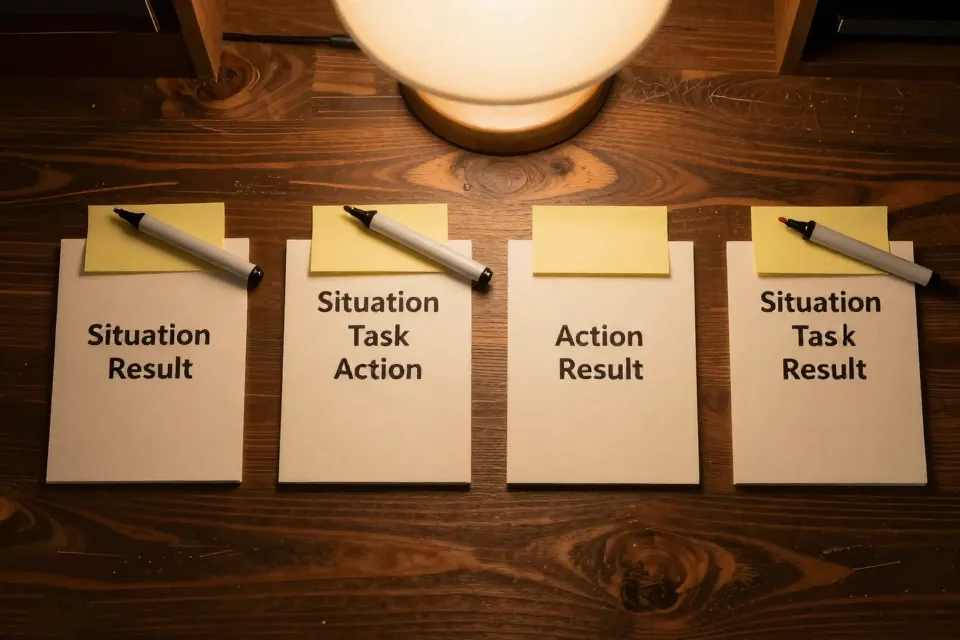
Behavioral questions, which almost always begin with phrases like 'Tell me about a time when,' 'What do you do when,' 'Have you ever,' 'Give me an example of,' or 'Describe a situation,' ask about your past because interviewers use it to predict how you will perform in the future. Muse career coaches recommend the STAR method for these answers. STAR stands for Situation, Task, Action, and Result:
- Situation: set the scene with only the details the listener needs.
- Task: name your responsibility or the goal you were given.
- Action: describe the specific steps you took, including people you worked with, tools you used, or plans you made.
- Result: share what actually happened, with numbers when you can.
Coaches suggest keeping each part tight, roughly one or two sentences per letter, and they note that the result is the piece too many candidates leave out, even though it often carries the most weight. If your story ends in a failure, close with the lesson you learned or the steps you took to improve. It is also perfectly acceptable to pause for a few seconds, or to say you need a moment, before answering a hard question.
Here is a simple example you can adapt. If the interviewer asks, 'Tell me about a time you solved a problem under pressure,' you might say: 'Our store ran out of a popular product the day before a big sale. My goal was to have it back in stock by opening. I called three nearby locations to find it, arranged a pickup, and asked a coworker to help restock before the doors opened. The shelves were full at opening, and we beat our daily sales target by about 15 percent.' Short, specific, and it ends on a measurable result.

Bring notes and practice out loud
It is fine to bring a small cheat sheet. Muse guidance says you can jot down the key details and numbers of your stories and refer to them during the conversation. Before the interview, review the job description, decide which three strengths matter most for the role, and prepare two or three stories you can adjust to fit different questions. Then rehearse. Harvard career resources suggest running a mock interview with a friend or colleague, or recording yourself on your phone and watching the playback. Practice makes your answers sound natural rather than memorized.
On the day: habits that help
First impressions begin before you say much at all, and research cited by Harvard career resources suggests interviewers often form an opinion within the first few minutes of meeting a candidate. Several small habits support a strong start. Plan your route and leave a buffer for traffic or transit delays, because many interviewers expect candidates to arrive a little early. When the conversation begins, focus completely on the speaker: listen closely, avoid interrupting, allow natural pauses, and connect your answers to something the interviewer just said. If a question catches you off guard, it is acceptable to take a few seconds to think rather than blurting out an answer. You should also be aware that a small number of questions are off-limits by law; Harvard career resources advise knowing which ones those are and how to respond if one comes up.
After the interview: send a thank-you note the same day
The handshake is not the finish line. CareerOneStop, a U.S. Department of Labor-sponsored career website, advises sending a thank-you note or email to your interviewer or interviewers as soon as possible, ideally the same day. A handwritten note, a typed letter, or a formal email all work; email is the better choice when the employer may decide quickly. Keep it brief: thank them for their time, restate your interest in the role, and reinforce one or two points from the conversation. The note is also a natural place to add anything you forgot to mention during the meeting.
Review for a possible second round
Many hiring processes include more than one interview, and CareerOneStop notes that you may well return to the same employer for another round. Right after your meeting, jot down which questions stumped you, what the interviewer seemed most interested in, and how you might answer more strongly next time. Keep that record handy. If you are invited back, you can build on your first conversation instead of starting from scratch.
Interview myths worth dropping
| Myth | The more accurate take |
|---|---|
| You must seem flawless | Interviewers want to see self-awareness and honest learning, not perfection (The Muse). |
| Saying 'I never make mistakes' sounds strong | Career coaches warn against claiming you have never erred; it signals low self-awareness (The Muse). |
| A fake weakness like 'I care too much' is safe | Coaches say pretend weaknesses do not count; pick a real, minor area and show improvement (The Muse). |
| Thank-you notes are outdated | Follow-up still leaves a lasting impression, according to CareerOneStop. |
A last-minute checklist
- Researched the company's mission, structure, and recent news
- Prepared a one- to two-minute answer to 'Tell me about yourself'
- Matched three strengths from your experience to the job posting
- Practiced two or three STAR stories out loud
- Prepared one or two smart questions to ask
- Planned the route with extra time for delays
- Sent a thank-you note the same day as the interview
Follow this checklist once, and you will walk into the next interview with a calmer mind and a stronger story to tell.
Want to test more career skills while you prepare? Browse the quiz library for quick practice.
Content on KnowHow Bench is for general information only. See our Disclaimer for details.